
|
Home
> College of Sciences
> Institute of Fundamental Sciences
> Maths First > Online Maths Help > Calculus > Differentiation > Tangents, Derivatives and Differentiation > The Slope |
|


|
|
|||
| |
|
|||
|
|
Tangents, Derivatives and DifferentiationThe Slope of a LineLet P = (x1,y1) and Q =(x2,y2) be two points on the Cartesian plane. The slope of the straight line passing through P and Q is
where
A vertical line has undefined slope because all points on the
line have the same x-coordinate . As a result the formula Differentiation Index | The Slope of a Tangent Line >> |


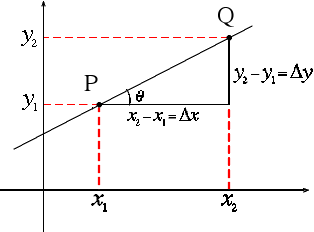
 and
and  and
we say "the slope is equal to the change in y relative to
the change in x" .
and
we say "the slope is equal to the change in y relative to
the change in x" . used
for slope has a denominator of 0, which makes the slope undefined.
used
for slope has a denominator of 0, which makes the slope undefined.