|
Home
> College of Sciences
> Institute of Fundamental Sciences
> Maths First > Online Maths Help > Algebra > Quadratic Polynomials > Completing the Square |
|


|
|
|||
| |
|
|||
|
|
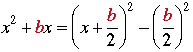
Quadratic PolynomialsCompleting the SquareWe now introduce the method of completing the square, which can be applied to solving any quadratic equation. First we deal with the case: x2 + bx + c (the leading coefficient is 1) We want to write x2 + bx + c = (x + h)2 − k (known as completing the square) Note (x + a)2 = x2 + 2ax + a2 Rearranging gives x2 + 2ax = (x + a)2 − a2 Write b =2a or a =b/2 Hence,
Example 9.Study a few more examples. ExerciseNow try to solve a few on your own. We can use this method to complete the square for any quadratic with a coeficient of 1 for x2. Examplesx2 + 6x + 31 = (x + 3)2 − (3)2 + 31 = (x + 3)2 + 22 x2 − 11x − 3 = (x − 5.5)2 − (5.5)2 − 3 = (x − 5.5)2 − 33.25 ExerciseNow try some of these exercises: Completing the square allows us to find the roots of a quadratic equation. ExamplesFind the roots of x2 + 6x + 5: x2 + 6x + 5 = (x + 3)2 − 32 + 55 = (x + 3)2 − 4 The roots are given by x2 + 6x + 5 = (x + 3)2 − 4 = 0 That is, (x + 3)2 = 4 Thus x + 3 = 2 or x + 3 = −2 That is, x = 2 − 3 = −1 or x = −2 − 3 = −5 Find the roots of x2 + 10x + 12 : x2 + 10x + 12 = (x + 5)2 − (5)2 + 12 5 = (x + 5)2 − 13 The roots are given by x2 + 10x + 12 = (x + 5)2 − 13 = 0 That is, (x + 5)2 = 13 Thus x + 5 = ExerciseNow try some of these exercises: << Roots | Quadratic Polynomials Index | The Quadratic Formula >>
|