|
Home >
College of Sciences
> Institute of Fundamental Sciences
> Maths First > Online Maths Help > Algebra > Logarithms > Rules |
|


|
|
|||
| |
|
|||
|
|
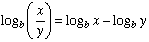
LogarithmsRulesSince the notion of a logarithm is derived from exponents, all logarithmic rules for multiplication, division and raised to a power are based on those for exponents. There are no general rules for the logarithms of sums and differences. Recall that when we
Translating these rules to logarithms we obtain: RulesFor all positive real numbers, logb(xy) = logb x + logb y
logb(xn) = n logb x with Special Cases: logb b = 1, as b1 = b logb 1= 0, as b0 = 1 ExampleExpress the logarithm of a number in terms of the logarithms of as few numbers of primes as possible. Try some of these yourself and check against the given answers. There are 8 examples to view. ExampleExpress the logarithm of an expression in terms of the logarithms of as few numbers of primes as possible. Try some of these exercises yourself and check against the given answers. There are 8 examples given.
<< The General Logarithm (Definition) | Logarithms Index | The Common Logarithm >>
|