
|
Home
> College of Sciences
> Institute of Fundamental Sciences
> Maths First > Online Maths Help > Algebra > Logarithms > Applications |
|


|
|
|||
| |
|
|||
|
|
LogarithmsApplicationsA logarithmic function can be used to transform an exponential
function into a linear one. For example, by applying ln to both sides
of
Example 3.Find x
such that Click on the question mark to see the next step in the solution process: Hint: Apply ln to both sides
Exercise 3.Solve the equation and round your answer to two decimal places: Example 4.Solve the equation Click on the question mark to see the next step in the solution process: Hint: Apply exp to both sides
Exercise 4.Solve the equation and round your answer to two decimal places: Example 5.Solve the equation Click on the question mark to see the next step in the solution process: Hint: Apply ln to both sides
Exercise 5.Solve the equation and round your answer to two decimal places: All logarithmic functions can be transformed to a function involving the natural log. Example 6.Suppose Then By taking ln of both sides we can solve for y. Click on the question marks to see the step-by-step solution:
Exercise 6.Express the function in terms of the natural log, using fractional answers, not decimals: e.g. The function y =(1/2)log2x expressed in terms of the natural log is y =(1/2)lnx/ln2 Don't type any blank spaces in your answer, and put brackets around any fractional numbers. |
 we get
 .
.





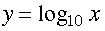 .
.

